
PSPi 6 Spontaneous Power-on Issue
After months of investigation, I’ve finally figured out why some PSPi 6 boards power on by themselves, usually when plugging in and charging after playing for a couple hours and then shutting down.
Investigation
The board would power back on immediately, sometimes repeatedly, until unplugged. A few users even had to remove the battery. At first, I couldn’t reproduce the issue at all, and it seemed to be caused by flakey power switches. Of the 9 Discord users reporting the issue, some were using high-current chargers and genuine PSP chargers, so I tried that first. I bought a bunch of chargers and ran half a dozen PSPi builds until I finally reproduced it. Narrowing down the exact cause was really difficult though. I could make the issue happen once, but as soon as I removed the board for diagnosing, the issue would disappear.
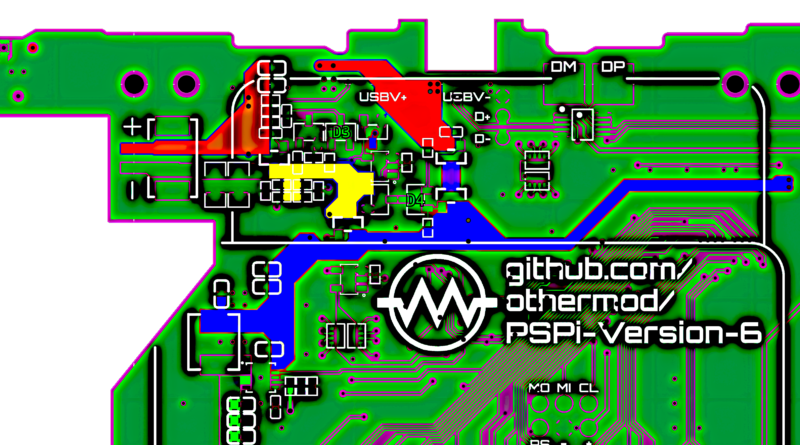
The PSPi 6 has a complex (for me) power architecture. It’s designed to limit battery wear by running entirely on DC power when plugged in, rather than cycling charging of the battery on and off like many portable devices do. It also allows charging and discharging through the same USB connector. These power planes are shown below, with red being DC input, orange being battery, and blue being the area where everything combines to power the Raspberry Pi. This required careful design to ensure power goes to the right places at the right times, and to prevent spontaneous power-on. I’d actually solved a similar issue on an early prototype, where plugging it in would cause a MOSFET gate to enable when not intended, and I assumed a similar cause was to blame here.
I finally made some progress last week. I wrapped everything in a heating blanket during testing, and I finally managed to reproduce the issue reliably.
Once I knew it was temperature-dependent, I was able to monitor each component during usage, shutdown, poweroff, and then sudden power-on. The problem is a single BAT54C diode on the power management circuit. When the board gets hot from extended play, this Schottky diode allows more current to leak through than normal. I never experienced this myself because I don’t typically run the kind of demanding software that heats the board up that much. In some scenarios, the CM4 generates enough heat to reach the temperatures where the BAT54C’s reverse leakage becomes a problem. With CM5 boards, the board gets hot enough that the leakage triggers power-on regardless of whether a charger is present. Pi Zero and Zero 2 users are unlikely to encounter this because those boards don’t generate enough heat to trigger the issue.
The Fix
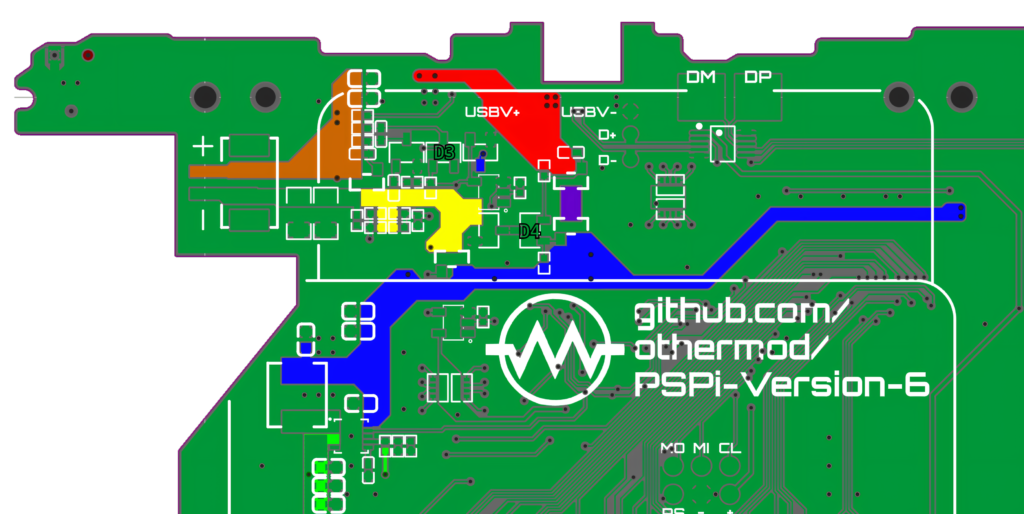
Replace the two BAT54C diodes (D3 and D4) with BAV70 diodes. D3 is the most important one, but D4 is identical, in the same general area, and connected to the MOSFETs between USB input and the board’s main power source, so I recommend swapping it too in order to be thorough. These diodes are in the exact same position on every board I shipped, all the way back to the “Early Adopter” board.
Original part: BAT54C (Schottky barrier diode)
Replacement: BAV70 (High-speed switching diode)
Package: Both are SOT-23, same pinout, no PCB modifications needed
The BAT54C is a Schottky diode with higher reverse leakage at elevated temperatures. The BAV70 is a standard silicon switching diode with better temperature stability and lower reverse leakage. All PSPi 6 boards manufactured on or after April 1, 2026 will include the BAV70 diodes. I am swapping them manually on each board before shipping.
If you have an older board and want to fix it yourself, the diodes are located on the power management section near the charging circuit, marked D3 and D4 on the image above. Desolder the old diodes and solder in the new ones. The pinout is identical. BAV70 diodes are available from LCSC, Digi-Key, Mouser, or any electronics supplier carrying Nexperia parts. Many other silicone diodes will also work, as long as the datasheet lists a reverse leakage current in nanoamps.
Do You Need This Fix?
If you haven’t experienced spontaneous power-on, you don’t have to do anything. The issue only manifests under specific conditions when the board is very hot. If you’re using a Pi Zero or Zero 2, you’re unlikely to hit the temperatures required to trigger this.
Final Thoughts
I know that not everyone is able to solder, and I’m willing to perform this modification myself on any board that I can get my hands on. Getting the boards in my hands is the tough part. If you’re in the US, shipping is pretty cheap, but half of my orders are international and the cost gets really pricey, especially two ways.
If you have thoughts on this, reach out on Discord or the contact page, or you can message below.