
Progress Report – July 2026
PSPi 6 Progress Update – July 2026
I posted a new video with an update on the PSPi 6 project. Here’s the same info in text form for anyone who prefers reading over watching.
Board Revisions
Since the last video, the board has gone through several revisions: PCB 0.8, 0.9, 1.0 (the first version I actually sold), 1.1, 1.2, 1.3, and now 1.4.
Along the way I switched to pogo pins for both the headphone board and firmware flashing, found a USB connector that could be machine-assembled instead of hand-soldered, and moved to custom joystick pins so they hold in place during soldering.
All the PCB revisions, with notes on what changed and the manufacturing files, are in the boards folder on GitHub.
The Power-On Bug
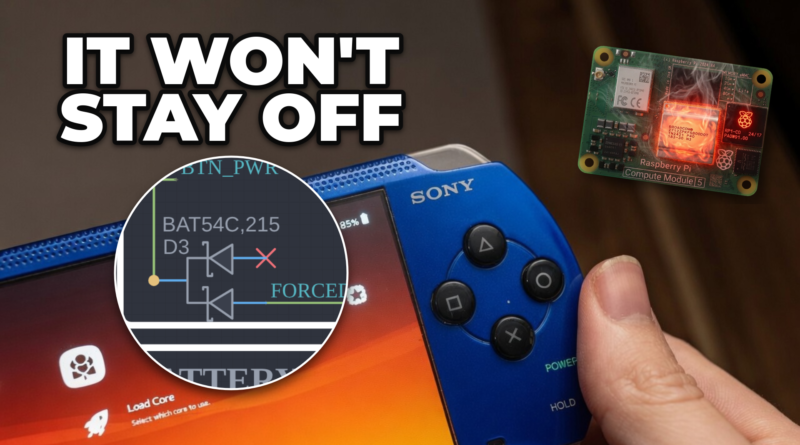
A power-on issue showed up later and took a long time to run down. It was first reported as boards turning themselves back on with no charger connected at all. I initially suspected a bad power switch, then high-current chargers, and spent a while testing both without landing on a real answer.
The clue that actually helped came from a report of the same issue on a CM5 board with no charger involved. That ruled out chargers and pointed at heat instead.
Once I could reliably reproduce it by heating a board during a stress test, it only took a few days to find the cause. Two diodes in the power circuit leak current once the board gets hot enough, and that leak trips the power switch on its own. CM5 boards run hot enough to hit this reliably. CM4 boards can hit it under heavy load. Pi Zero and Zero 2 boards run cool enough that it isn’t an issue. I wrote up the full diagnosis and fix in an earlier post, and I’ve been swapping the diodes on every board before shipping since April 1st.
CM5 Status
The CM5 isn’t officially supported yet, but it does mostly work on the existing CM4 carrier. There are two real limitations. It runs hotter than the CM4, which is still something to manage even with the power-on bug fixed, and the CM5 changed pin mapping enough that onboard audio doesn’t work at all right now, so Bluetooth or USB audio is the only option.
Universal Carrier
Work has resumed on the Universal Carrier board, aimed at getting the most out of both CM4 and CM5, with some attention to clone boards too. Components are selected and I have rough layouts done. Prototypes are next.
Software and Documentation
The GitHub repo got a full restructure. It’s better organized now and easier for anyone else to contribute to. OS images are also now built automatically through GitHub Actions instead of by hand, so you can see exactly what’s being downloaded, compiled, and modified for each image instead of just trusting me on it. Cory Manson (Cozza in the Discord) did the groundwork for that, and it makes iterating a lot faster too. Only a couple of images are built this way so far, but that’ll grow. Older images like Ubuntu and Kali are still up on Proton Drive in the meantime.
The gamepad driver now auto-detects across most operating systems and emulators with no configuration needed. The left switch controls WiFi the same way it did on the original PSP. And I rewrote the battery percentage calculation using real discharge data, so it’s a lot more accurate at low charge and doesn’t jump around under load.
I also finally moved off the old video driver and onto the modern KMS driver Raspberry Pi now uses. I’d been putting this off for a while because my on-screen display relied on the old method, and there’s no equivalent under KMS. The part people actually cared about was the battery indicator, so I wrote a driver that emulates a standard battery device. The OS now shows its own native battery indicator instead of the custom one I built.
The wiki has also been rebuilt from scratch. It’s a clearer explanation of what the project is, what to buy, and includes a full photographed build guide. If you’re new to the project, that’s the place to start.
The last few months of progress came down to leaving my day job to work on this full time. Most of that time went into the GitHub restructure, the documentation, and the power-on bug rather than anything visible, but it’s done now and I’m ready to get back to making videos regularly.
Contributing
This is still a solo, open source project, so contributions of any kind are welcome.
10-Year Giveaway
This month marks 10 years since I started the PSPi project. To celebrate, I’m giving away a PSPi 6 board, headphone board, and carrier. Enter via the Google Form, and I’ll announce the winner in a week.